Juvenile Justice in Alaska
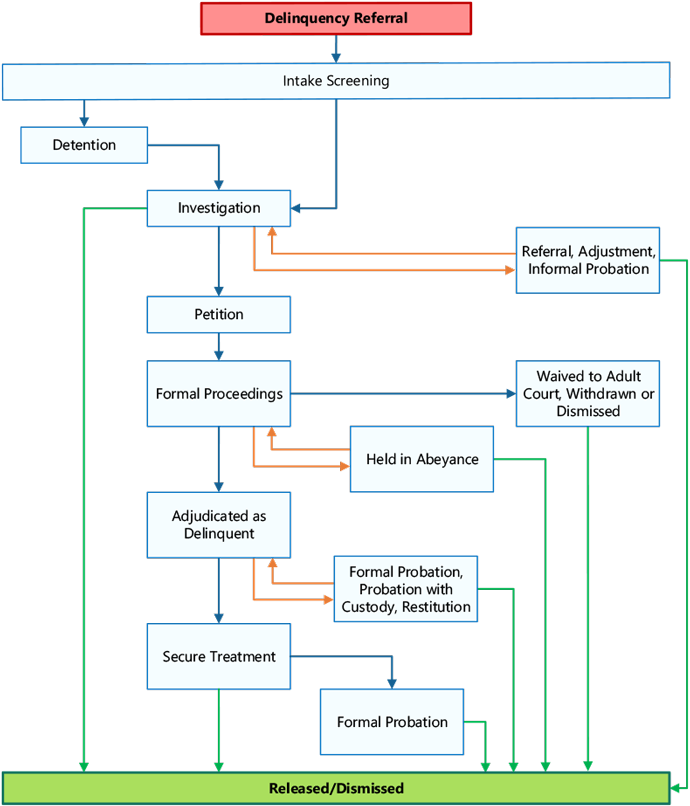
Juvenile Justice is a comprehensive process of prevention, intervention, and rehabilitation. The system used by the State of Alaska Division of Juvenile Justice, which is reflected in the flowchart, below, shows the areas of DJJ responsibility and the steps that juveniles may move through the system. Each step in the process serves a specific role in determining the most appropriate and effective response to a juvenile offender's behavior.
Many of the terms used are specific to juvenile justice or to the courts and may be new to you. To assist you in understanding the process, we have provided
definitions for each of the steps listed in the flowchart.
Click on a step on the flowchart below to see the definition.
Definitions
Delinquency Referral
A delinquency referral is a police report alleging someone under the age of 18 committed a crime or violation (or was under the age of 18 at the time of the alleged offense). The police report is sent to DJJ by a law enforcement agency.
Intake Screening
A police report is received by DJJ and reviewed for legal sufficiency. A decision is made regarding what the next step should be – the immediate arrest and detention of the youth, or further investigation.
Detention
Detention is when a youth is arrested and detained for a criminal offense or violation in a secure facility. Immediately following a youth’s arrest and detention, further investigation is done and a decision made within 48 hours to determine if the matter should be handled formally (in court) or informally (outside of court).
Investigation
A Juvenile Probation Officer’s (JPO) investigation often involves an intake interview with the youth and family and collateral contacts such as the school, law enforcement, victim(s), and other parties that might have information to offer regarding the youth’s current situation, the validity of the allegations, and if formal or informal action is the most appropriate. At the conclusion of the investigation, a JPO will determine if the matter should be handled formally (in court) by filing a document called a petition, or informally (outside of court).;
Referral, Adjustment, Informal Probation
DJJ has a number of informal (outside of court) options to offer youth who have been referred for an offense through an agreement between the youth and the JPO. A referral to another agency or program – like Youth Court, mediation, substance abuse evaluation/treatment, or behavioral health evaluation/treatment is an option. An adjustment agreement or informal probation may also occur. In all instances, if a youth successfully completes the terms set forth in the agreement, the matter is resolved. If a youth fails to abide by the terms of the agreement, the matter is investigated again and formal court action can occur.
Petition
A petition is a legal charging document filed with the court by the JPO. The petition sets forth the facts of the case as the JPO understands them based on police reports, intake interviews, and any other investigation the JPO may conduct. Once a petition is filed an arraignment hearing will be scheduled – beginning the process of formal proceedings.
Formal proceedings are hearings before a judge regarding the information filed in the petition. A youth has the right to be represented by an attorney and have a judge or jury make a finding regarding their guilt or innocence.
Waived to Adult Court, Withdrawn or Dismissed
Once formal proceedings have begun DJJ has the option to withdraw a petition before arraignment and shift back to informal options for resolution. Waived to adult court is when a youth over the age of sixteen commits an offense for which they can be prosecuted and convicted as an adult. This requires special filings by the District Attorney and findings of the court to make a determination that the youth is waived to adult court.
Held in Abeyance
During formal proceedings, but before adjudication (conviction) the court can order that a youth’s adjudication order be held in abeyance. This means that the youth will be supervised by DJJ under conditions ordered by the court for a specific amount of time. Upon successful completion of the supervision, the offense(s) will be dismissed and the youth will have no formal adjudication history.
Adjudicated as Delinquent
A judge or jury finds that a youth is guilty of the petitioned offenses and a judge enters an adjudication order. This is similar to being convicted of a crime as an adult.
After adjudication a judge will determine what the most appropriate response is to the youth’s delinquency and adjudication. There is specific criteria that the court must consider in making this order. The judge will order conditions of probation, which the youth is required to obey and DJJ supervises and reports violations of to the court. The youth can be at home or the community on probation, often referred to as a b2. The youth can also be placed in a non-secure treatment program, foster home, or other licensed, out of home placement in the custody of DJJ and on conditions. This is often referred to as a b3. Further, the court can order a youth and their parents to pay restitution to compensate victims for losses they incurred as a result of the youth’s criminal behavior.
Secure Treatment
The youth is adjudicated and the court determines that the youth is in need of secure treatment in a DJJ facility. This is often referred to as a b1 order.
Released/Dismissed
A youth’s involvement with DJJ ends when they have successfully completed their court ordered conditions and/or order, agreement with the JPO, or the matter is dismissed.
[BACK TO TOP]